-
What’s new in epitome v_0.03? – a (not-so) technical report
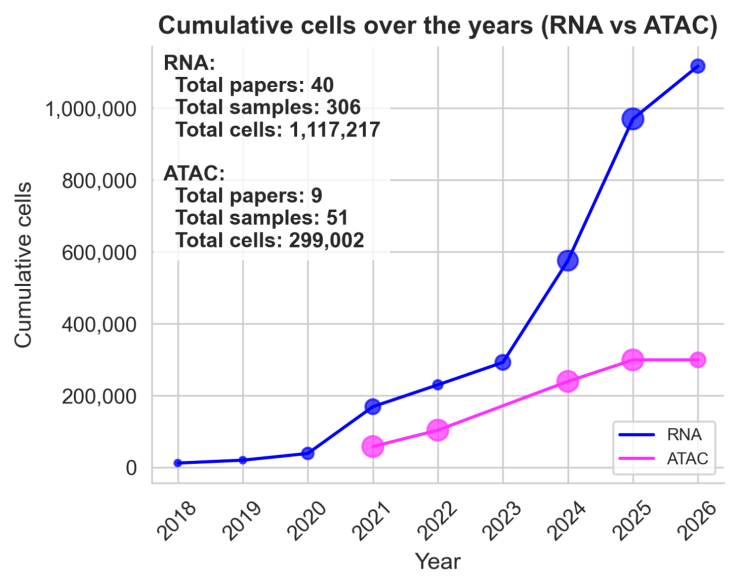
Image: Exponential adoption of single-cell profiling in the pituitary gland.
There isn’t really a proper venue for writing brief updates to existing scientific projects. Publications typically require major novelty and each submitted paper is burden on the crumbling peer-review system. So I’ve decided to make this a blog post, in which I’ll explain some of the updates on our epitome platform (epitome-atlas.com), which has become a central resource for pituitary gland research. I’ll try to write something short like this for each release, so that users can keep track of what’s new.
A brief summary of what’s new in release v_0.03.
User interface
In the near term we will expand to human datasets, and therefore redesigning some aspects of the website was crucial. Along with this, some improvements to the user-interface were also made, which now looks a bit more professional than before.
New data
Added new datasets from Sochodolsky et al. (2026) that were missed in v_0.02, data from Refael et al. (2026), Weber et al. (2026) and Odle et al. 2026.
Find the papers referenced at the bottom of the post.
New datasets have all been annotated automatically with the v_0.02 cell type model (as taken from Kövér et al. 2026).
Updated results
All differential expression analysis (markers, sex and age analyses) have been repeated with the expanded dataset. The added data have further improved the robust findings in the atlas, as I will show below.
For lineage markers, comparing the various splits in the pituitary lineage (for explanation see Kövér et al. 2026 and the figure below) most markers remained in agreement with the previous version (v_0.02), and more accurate estimates now added (blue) and removed (orange) some markers.
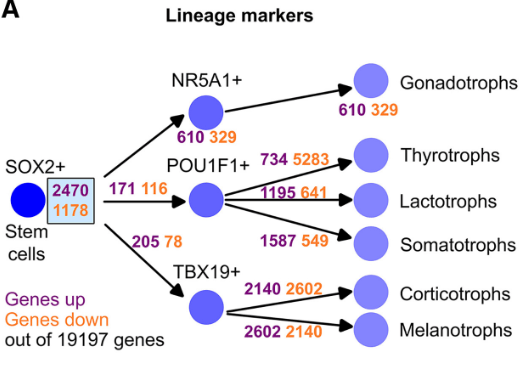
Fig 5A from Kövér et al. 2026
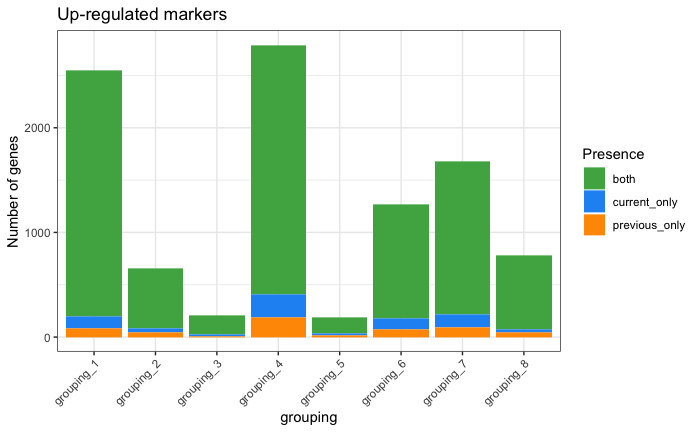
Bar plot of overlapping and changing markers across atlas versions.
When comparing P-values between versions, we see that now with more data, the P-values tend to be more significant in the atlas, because of course we have stronger statistical support to each claim due to the higher sample size. Overall P-values seem really nicely correlated with the previous version, showing that adding all this new data didn’t totally mess things up, just made findings more significant in general.
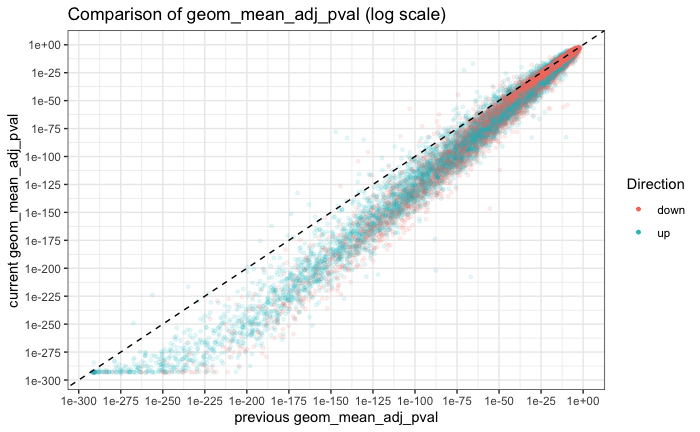
Scatter plot of P-values across atlas versions.
For cell typing markers, the situation is very similar, there is almost a total overlap with the previous (v_0.02) and current (v_0.03) markers.
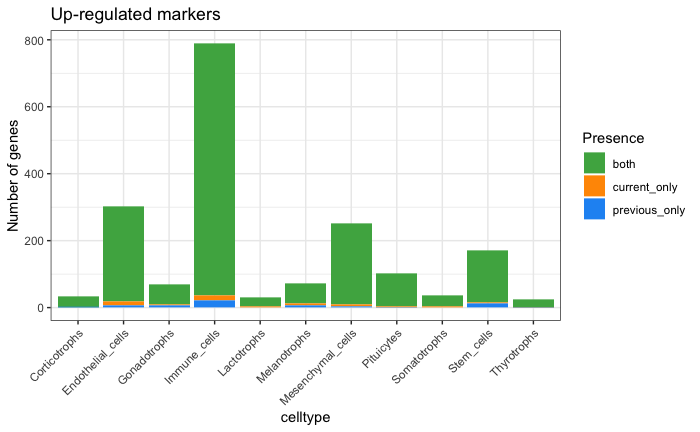
Bar plot of overlapping and changing markers across atlas versions.
And as before, the P-values are strongly correlated, but typically more significant than before.
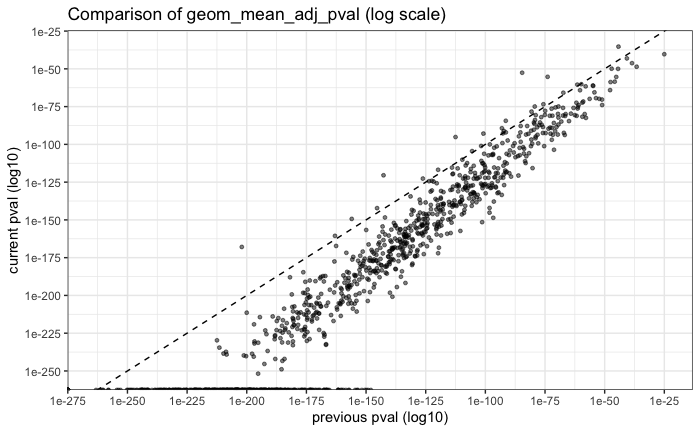
Scatter plot of P-values across atlas versions.
For sex-biased gene expression, the findings are also largely consistent with the previous results, with minor adjustments. For this specific analysis, only some of the newly added datasets were used, and none of the Parse biosciences datasets (as in the paper), which previously seemed to have some male-female cross-contamination.
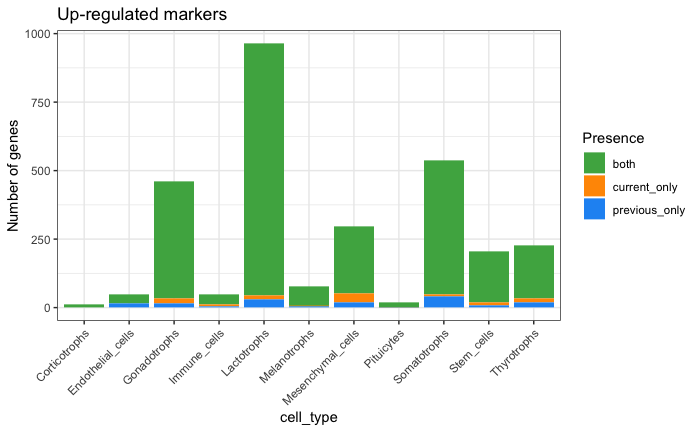
Bar plot of overlapping and changing markers across atlas versions. Upregulated here means male-biased markers. Female-biased markers not shown, but is qualitatively similar.
Here too, P-values are strongly correlated between the two versions, and somewhat more significant in the new version.
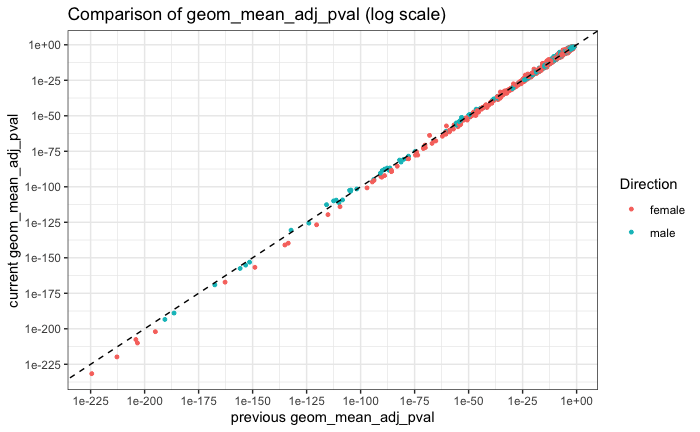
Scatter plot of P-values across atlas versions.
For age-dependent changes, there were also slight updates, mostly resulting in slightly higher significance for genes with already clear patterns.
Downloadables
Improved formatting of downloadable objects, by cleaning up their metadata. The AnnData objects now include a tidier .obs metadata section after removing a lot of repetitive junk columns. This should facilitate easier reuse of the datasets. The integrated objects and individual datasets now also include the recently added datasets from this release.
What can one do with all this new data?
I’ve heard very cool use cases from a lot of labs, but one thing in particular that I find exciting with the new datasets (and I don’t have time to look at) is estrous cycle variation across the pituitary cell types. With the added datasets, there is now about 60 or so samples with estrous cycle labels, so someone could definitely find something novel there. If you are interested, get in touch and happy to brainstorm on this.
Closing
Usually single-cell atlases (and most biological resources) are just published but not properly maintained. At least for the foreseeable future I will try to maintain epitome as much as I can, and keep users updated on new features.
Go check out epitome: epitome-atlas.com
Cite the paper
Kövér, B., Willis, T.L., Sherwin, O., Kaufman-Cook, J., Kemkem, Y., Segoviano, M.V., Lodge, E.J., Zamojski, M., Mendelev, N., Zhang, Z., et al. (2026). Consensus Pituitary Atlas, a scalable resource for annotation, novel marker discovery, and analyses in mouse pituitary gland research. Cell Rep. 45. https://doi.org/10.1016/j.celrep.2026.117407.
Papers with the new data
Weber, R., Carilli, M., Rebboah, E., Filimban, G., Liang, H.Y., Trout, D., Duffield, M., Mahdipoor, P., Taghizadeh, E., Fattahi, N., et al. (2026). Hybrid crosses reveal a cell-type-specific landscape of mouse regulatory variation. Preprint at bioRxiv, https://doi.org/10.64898/2026.04.02.716195https://doi.org/10.64898/2026.04.02.716195.
Odle, A.K., Miles, T.K., Herdman, A.K., Clark, L.G., Byrum, S.D., Lagasse, A.N., Haney, A.C., MacNicol, A.M., Childs, G.V., and MacNicol, M.C. (2026). Gonadotrope remodeling in sustained low estrogen states: single-cell transcriptomic analysis reveals gonadotrope subtypes and activation of stem cell populations. Biol. Reprod. 115, 145–160. https://doi.org/10.1093/biolre/ioag091.
Sochodolsky, K., Khetchoumian, K., Balsalobre, A., Feeley, R.M., Rice, M.E., Chakravarty, P., Lovell-Badge, R., Rizzoti, K., and Drouin, J. (2026). BDNF regulates pituitary stem cell engagement toward precursor state. Stem Cell Rep. 21. https://doi.org/10.1016/j.stemcr.2026.102997.
Refael, T., Golan, G., Darsa, D., Pnueli, L., Chakravarty, P., Rizzoti, K., and Melamed, P. (2026). Accessibility at a primed distal Fshb-Kcna4 super-enhancer is facilitated by Foxl2 during gonadotrope differentiation. Endocrinology 167, bqag028. https://doi.org/10.1210/endocr/bqag028.
-
Standing on the shoulders of giants: what led to the Consensus Pituitary Atlas

I often find it more interesting to hear how projects are conceived than how they are executed. The daily aspects of science are often dull, experiments and data analysis tasks often follow well-established protocols. I find the dichotomy of “day” and “night” science, as popularised by Jacob (and a recent amazing podcast series), to be a very accurate description of this phenomenon. “Day science” involves pipetting liquids, preparing samples for experiments, performing those experiments and analysing the results. On the other hand, “night science” involves the more fun part of science, like hypothesis generation, speculation on grand ideas, and the synthesis of everything you have read before into some sort of a crazy amalgamation – which hopefully turns out to be a novel idea. I have heard the phrase attributed to Newton “if I have seen further, it is by standing on the shoulders of giants”, but never fully grasped what it really meant. That was until I started to see the giants whose shoulders I have been standing on.
Here, I refer to our recent work on the Consensus Pituitary Atlas, which is the largest uniformly processed database of pituitary gland single-cell RNA-seq data (if this doesn’t mean anything to you, don’t worry, the blog post is not very technical). We position the CPA as a central resource (especially through the epitome platform) for the field in the years to come, soon incorporating data from human patients and all available species. When one opens the CPA paper, it is stated that along with my supervisor, I have conceptualised this study, but what does that really mean? In what sense did I conceptualise any of this? In this blog post, I will summarise what I think were the key events leading to the conception of this project. I am hopeful that sharing this journey will be useful in describing the scientific process for other PhD students, and that if any undergraduate students read this, it will motivate them to pay attention in their classes. What follows below is a rough timeline in bullet points.
In Justin Bois’s BE-BI-103A course in 2021, I learned Python and became familiar with Github, Jupyter notebooks and almost everything I use on a daily basis now. I’ve also learned data analysis and statistics (technically I’ve learned this at UCL before, but it was nothing in comparison).
I first heard about single-cell RNA-sequencing in 2022 on Lior Pachter’s course at Caltech, called Bi-BE-CS-183. It is funny to think that by that point, most of the existing pituitary gland datasets had already been published. In fact, when the first single-cell paper on the pituitary was published in 2018, I was still in high school. Besides learning about single-cell RNA-sequencing, this course gave me a strong foundation for the necessary intuition and mathematical skills for single-cell analysis. Since then I’ve been following Lior’s blog, which is one of the best blogs for people interested in genomics and science in general.
Still on the same course (Bi-BE-CS-183) in 2022, I’ve read Valentine Svensson’s 2020 paper that curated all existing single-cell datasets (I think the database is still frequently updating, though likely not comprehensive anymore). This paper demonstrated the opportunities that arise from systematic analysis following proper data curation. Since then I’ve been following Valentine’s blog, which I also highly recommend.
And still on the same course, I’ve learned of the tool kallisto-bustools from the Pachter lab. I remember hearing in the class that this enables you to align single-cell datasets on a laptop in about an hour, compared to other much slower, resource-intensive software (e.g. 10X Cell Ranger). While I understood that kb-python allows you to align datasets in 2 lines of code, I didn’t understand anything about how the command line worked, and found the whole subject way too scary.
We had a guest lecture on Justin Bois’s BE-BI-103B course in 2022 from a previous student Griffin Chure. The main takeaway was that data from papers are better communicated as dashboards, and that this is the future of presenting scientific data. Also, Griffin showed a website that was able to reproduce all of his findings from his PhD, I thought this was super cool, but seemed quite difficult to make.
After my year at Caltech, I’ve done a summer project at UCL. The lab where I was based has never looked at any single-cell datasets, and I thought this was a good time to maybe get involved. This was the first time I’ve analysed some already pre-processed single-cell data in Seurat.
In my Master’s project at UCL, I worked on multicellular-like phenotypes in fission yeast. I’ve previously written about the many things this project has taught me, including the use of publicly available data. In my Master’s, I performed tons of experiments (yes, yeast is amazing), but I’ve also used 7-8 publicly available large transcriptomic datasets that I was able to fit into my narrative. Without those public datasets, it would never have been possible to build a strong narrative, which eventually resulted in my first publication.
Still during my Master’s I saw that the Pachter lab wrote two papers on the Commons Cell Atlas, and associated algorithms (I don’t think these two pre-prints ever got published). These papers illustrated that some minimal data curation and some lightweight processing workflow can quickly assemble large atlases from publicly available data. It was around this time that I also learned how to fetch raw data from the Sequence Read Archive, but it took me a while longer to figure out what to do with it.
It was at this point that I started my PhD, and I already had many of the necessary ingredients for the CPA: single-cell RNA-sequencing analysis, data curation, using publicly available data, large-scale data processing, dashboards to communicate data, reproducibility.
It is only after reading this that I realised how much of a product of my early scientific training I really am. I consider myself incredibly fortunate to have had these formative experiences, without which, evidently, I wouldn’t be where I am today. While my PhD project technically started in late 2024, and the paper got published in May 2026, in some sense, the Consensus Pituitary Atlas dates back to 2021/2022. Most of these concepts are based on work done by other incredible people, and these ideas have been marinating in my head just long enough that eventually the CPA seemed like a project worth pursuing. Of course, before my PhD I knew nothing about the pituitary gland itself. And obviously, there was a lot of amazing input and supervision that I have received throughout my project from my supervisor Cynthia Andoniadou, but this blog post was meant to highlight everything that led me to do this project from way before my PhD. If there is any takeaway, then it is that one should be receptive to ideas throughout their training and scientific career, and when the right moment comes, these ideas might align just well enough to lead to a great project.
-
Essays that got me a First at uni
Edit: Apparently this has been now read by thousands of students (I am guessing, mostly at UCL) over the last couple years. I’m glad if it was helpful.
As a biology student at UCL, I had to write many essays over the years. (This is because for some reason biology is taught as an essay-based subject in the UK, which is interestingly not the case in the US, or at least not at Caltech, where assignments are mostly problem sets.) When I started university, I had absolutely no idea how to write a good essay, as it wasn’t something I had ever been taught back in Hungary where I grew up. Furthermore, there is very little guidance even at university on how to write a proper essay, and most students either get it by themselves or they don’t.

I have put a lot of effort into some of my essays, and along the way found the “recipe” for writing a First-class essay. For those not based in the UK, a “First” is the best mark you can get at a UK university, and this generally means >70% for an essay, which about a quarter of students get each time. The difficult part isn’t to get a good grade once, but do to so reliably, and I managed to do this for every single essay/exam in my studies. I ended up ranking #1 on my degree twice with an average of >80% over the years.
Sadly, most of these essays, however good they are, usually get lost after the assignment is done. I thought that I would dig my essays out and put them on the internet for free, so that hopefully some students can learn from them. These are of course not scientific publications, have not been peer-reviewed, and have not been changed since their submission (even though feedback was received and errors were identified). The whole purpose of this blog post is so that students can have a reference for what is usually a First-class essay. This is important because typically no one will teach you how to write an essay, you are just expected to *know* how to produce them. The essays below range from things like the evolution of complex life, and the biology of ageing, to CAR-T cancer therapies and much more.
For some of these, I don’t even remember any of the content, so it was also quite a nice experience for me to re-read them.
Of course, it goes without saying, but it is not advised to copy any of the content here, because Turnitin will flag you for plagiarism. However, feel free to adapt the citations and ideas from these essays to fit your work. Don’t need to cite this page or anything, but please leave a like if it was useful.
Below is a list of some essays/exam answers that might be useful to you. If I find some of the other ones I might update this page. I will group these based on year and course code.
2022/23 UCL
- Instructive, modulatory and essential regulators of transcription (CELL0016) – My fastest written essay that I wrote basically in one night with the one below
- News and views – Single cell RNA seeks’ to understand hematopoiesis (CELL0016)
- CELL0016 exam 1. Essay on cellular senescence 2. Measurements of gene expression
2021/22 Caltech
2020/21 UCL
- Ageing as a continuation of development (BIOL0013 The Biology of Development – My highest graded essay >90%)
- Nodal flow and the initial establishment of left/right asymmetry in Bilateria (BIOL0013 The Biology of Development)
- Is complex life genuinely improbable? (Energy and Evolution)
- How falling atmospheric CO2 levels drove the evolution of megaphyll leaves and C4 photosynthesis (Energy and Evolution)
2019/20 UCL
- What is Urbilateria? What we know about its characteristics and how they were inferred (My first essay ever)
-
How to Ace a Master’s Project in Biology

Over the previous academic year, I completed my Master’s project at UCL, and during this time I have thought quite a bit about what makes such a short project successful. To be clear, when I say successful, what I have in mind is that the student has learned new skills and managed to create a standalone well-rounded piece of work. Note that this may not be the same as getting a good mark or being able to publish your work, however, usually these things go together. The most important transferable skills one can gain during a Master’s project are those related to experimental design, data analysis and scientific writing. (These are also exactly the kind of skills that will make you a desirable applicant to PhD programmes.) It is easy to see how the acquisition of these skills is directly related to the number of experiments one can perform.
Essentially, the more experiments you have, the more times you can go back to the drawing board and rethink your approach. Similarly, the more experiments you perform, the more data you will be able to analyze and report on. The actual subject of your work matters very little in this case (it’s unlikely to be revolutionary anyway), what matters is the number of high-quality experimental results you can obtain. In this blog post, I will discuss how one can maximize the amount of such experimental results by (I) choosing the right model system and (II) incorporating data from published work.
Busy Master’s student. Made with https://www.bing.com/images/create.
I initially started thinking about these questions after having read Uri Alon’s paper How to Choose a Good Scientific Problem (which is well worth reading). In it, he has a diagram illustrating that the difficulty of a project and the knowledge gained from it shows an obvious trade-off, such that a project that uncovers more knowledge is generally more difficult. He argues, that different combinations of difficulty and discovery might present suitable project options depending on the stage of one’s career. Easy projects, which probably won’t discover a cure for Alzheimer’s, are still fitting for early career researchers, whereas complex problems are suitable for a long-term vision of an entire lab. Here I introduce a third (somewhat independent) axis to Alon’s way of thinking, which is the rate at which one can do experiments. This is crucial because everyone working in a lab is limited by time, either because they will eventually graduate, or because their fixed-term employment/fellowship is over. As such, it is also crucial to consider whether a project can accumulate results fast enough.
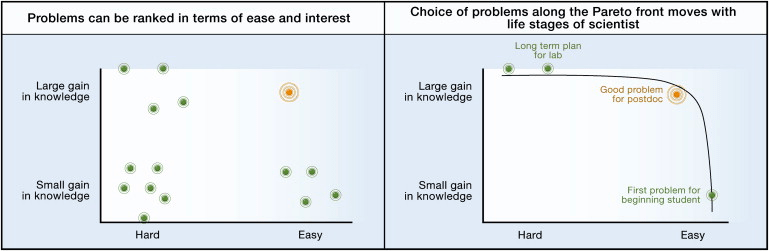
“Two axes for choosing scientific problems: feasibility and interest.” Source: Uri Alon: How to Choose a Good Scientific Problem. doi: 10.1016/j.molcel.2009.09.013.
As I said, the main focus of a short project is not to discover something revolutionary but to pick up useful skills as a young scientist. So one can pretty much ignore the “Gain in knowledge” axis and only consider difficulty. However, for a Master’s student who has 6-12 months in a lab, it is not enough for a scientific problem to be easy. They will also need to be able to maximize experimental data collection in this short timeframe. At the extreme, consider someone trying to study whether a certain drug makes mice live longer. This is in principle a very easy question, with a relatively simple experimental design which I will leave to the reader. But given that mice live for about 3 years long, this is already impossible to answer within a Master’s project. Now imagine, you are doing the same experiment on fruit flies (3 months), worms (3 weeks) or yeast cells (3 days), which will allow you to perform at least 4, 14 or 122 experiments respectively. (These will also give you less and less exciting results, but as I said, revolutionary findings are not the point anyway.)
Additionally, even an experiment that takes two weeks, does not truly require two weeks of complete attention, and usually, multiple such experiments can be run in parallel. So the maximum number of experiments one can perform in a given timeframe depends on two things: how long an experiment takes, and how many experiments can be done in parallel.
We can assume 300 working days with 4 hours dedicated to experiments each day. Further, let’s be optimistic and assume that half of the experiments will work and provide useful data. We obtain the following number of successful experiments:
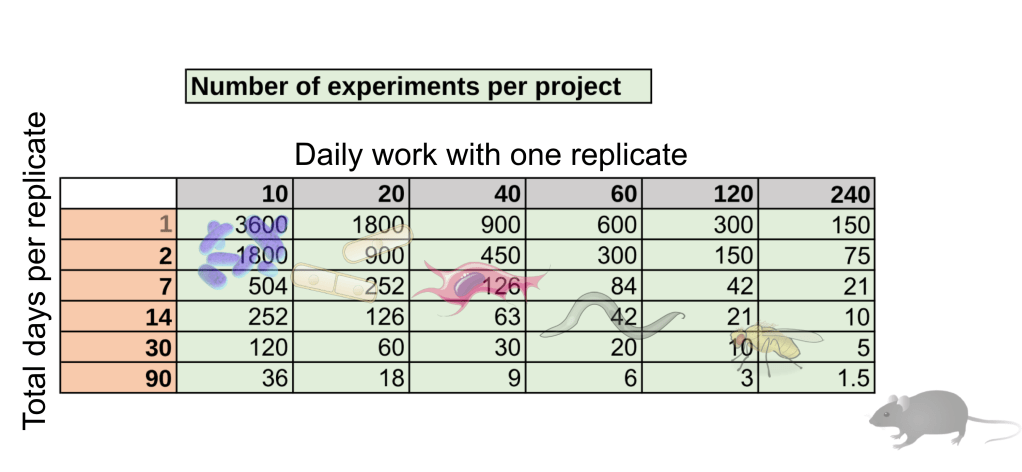
Table 1.: Number of experiments in a 12-month project, assuming 300 working days with 4 hours dedicated to experiments each day and a 50% success rate. Depending on Daily work (minutes) and Total days per replicate, one can calculate the maximum number of successful experiments. Images of organisms mark different experimental regimes, but obviously, these strongly depend on your scientific problem and approach as well.
We can immediately see that working on a system where experiments can be done both rapidly and in a highly parallel manner will allow one to obtain orders of magnitude more data compared to someone working on time-consuming experiments. As I have already mentioned, this depends entirely on the model system one works on, and specifically on its rate of cell growth (e.g., a flask of E. coli grows up overnight, while mouse embryonic development, let alone aging, takes long). This broadly speaking creates the following hierarchy:
E. coli > Yeast > human cells (fibroblasts, cancer lines etc.) > worms > flies > stem cells > mice
It was based on this simple logic that I chose to work on yeast for my Master’s project (also using lots of E. coli for various molecular biology reasons). For context, in my project I worked on the genetics of multicellularity in fission yeast cells. (To be exact, for various reasons it is not actually “true multicellularity”, and we termed it multicellular-like phenotypes.) Generally, yeast cells take 2 days to be grown after being taken out from the freezer, and it took another 4 days to grow 96 such strains in a very specific arrangement, after which we could assay them (in about 2 minutes) for adhesion. My daily tasks involved maybe on average 5 minutes with an experimental replicate of this sort. This simple experimental setup with code-automated analysis allowed me to assay various yeast libraries, including a genome-wide deletion collection. Then I was able to find both environmental conditions and gene mutations that trigger the formation of multicellular-like phenotypes. When I read or found something interesting, I could immediately go back to the drawing board, propose a new experiment, and get the results in a week. This is all because my project took place in the upper left corner of Table 1.

Me during my project (Or at least how I remember a year later). Made with https://www.bing.com/images/create.
Others in my department weren’t so lucky, and had projects in the lower right corner of Table 1. These were projects in which they counted the number flies or worms alive throughout the lifetime of an entire population. These took 4-6 hours daily, and experiments lasted 3 weeks or 3 months, for worms and flies respectively. Needless to say, such projects are much more risky, because if things go wrong (e.g., contamination, expired chemicals), one might end up with barely any useful data to analyze. And indeed, many people I know who did similar projects had trouble finding anything interesting.
Some of the other students in my department. (Or at least how I saw them.) Made with https://www.bing.com/images/create.
Conclusion 1: Choose your model system wisely. The more experiments you can do the better.
However, one is still limited in the amount of data they can gather on their own in 12 months. Therefore a great way to further increase the amount of data in your project is to incorporate results from published work. Suppose you find an interesting gene in your project, and you wish you could perform RNA-seq or proteomics to further explore what happens when that specific gene is deleted or perturbed in some way. Well, there might already be such data available! People perform experiments for many different projects, perhaps completely unrelated to what you are interested in, and therefore you could still discover something interesting using their data. Additionally, in the case of model organisms, like fission yeast, there are lots of large-scale experiments which generate vast amounts of data exactly for this purpose, to be used by other people.
As an example, I found that phosphate starvation in fission yeast results in formation of multicellular-like phenotypes. Of course, there was a recently published RNA-seq dataset of fission yeast under phosphate starvation, and guess what I found, that cell adhesion genes were indeed upregulated. As another example, I also found the deletion of the gene srb11 to cause multicellular-like phenotype formation. Luckily there was microarray data available from deletion of genes that function together with srb11. Interestingly they all upregulated cell adhesion proteins, through a pathway we suspected already.
The point is that performing experiments like RNA-seq are expensive and require time. However, if you can just incorporate such data from external sources, your project will benefit a great deal. And it does not matter at all that you did not collect that data, so long as you can incorporate it in your project in a unique way.

There is lots of publicly available data to explore! Made with https://www.bing.com/images/create.
Conclusion 2: Look for external datasets that you can use in your project. This provides you with much more information, while saving you time and money.
To wrap up, we can consider the relationship between the amount of experimental data and project progress. We can reasonably assume an exponential relationship. In this framework, accumulating more data eventually leads to getting more “bang for your buck”. At given levels of progression, we can visualize milestones, such as reaching sufficient statistical power, finding something meaningful, building a story, and at the very end, reaching a publishable level. My claim is that if you choose your model system wisely, and smartly incorporate other people’s work, then eventually you will get more and more out of it. (E.g., once you’ve incorporated external data properly, your next experiments are more likely to show something interesting. Or the other way around, if you performed good experiments, external data might further strengthen your argument.) You will reach important milestones in your project much faster, and much easier, while others will run out of time, and hand-in substandard work. So what’s the best decision you can make to have a successful short project?

Exponential curve showing one’s progress in a project as experimental data is gathered. A bad project will run out of time before reaching important milestones. A good project will allow for lots of experimentation and use of external data, and will complete all milestones in time.
Conclusion 3: Go work on yeast!
If you are interested in how the project I was part of turned out, you can now read our pre-print on Biorxiv! (I will probably write a blog post on this as well.)
https://www.biorxiv.org/content/10.1101/2023.12.15.571870v2
Additionally, thinking about this made me realise that most of microbiology should/could be repurposed to serve an educational goal for young scientists, especially because microbiology is losing funding and in general becoming less relevant (partly due to the explosion of good human models). So expect something on this in the future as well.
In the meantime, if you found any of this interesting, get in touch.
-
London based PhD programmes in the biosciences (2024)
This a list of London-based PhD programs in the biosciences that I will keep updating. It is not supposed to be an exhaustive list, just a starting point for people who are only starting to look now. If you think I forgot to include a good programme, get in touch and I’ll add it to the list.
King’s College London and Wellcome Trust (the one I’m doing):
https://www.regenerativemedicinephd.co.uk/
King’s College London and Wellcome Trust
https://www.wellcomeneuroimmunephd.co.uk/
University College London and Wellcome Trust
Cancer Research UK – City of London Centre
https://www.colcc.ac.uk/phd-studentships/
Francis Crick Institute
https://www.crick.ac.uk/careers-study/students/phd-students
Queen Mary:
King’s:
Imperial:
https://www.imperial.ac.uk/multisci-mrc-dtp/
UCL:
-
How to get a PhD studentship in the life sciences

A PhD student in London. Image was created with https://openai.com/dall-e-2/ At the time of writing this, I’m currently an integrated Master’s (MSci) student in Cell Biology at University College London, and will start my PhD at King’s College London in September 2023. In this blog post I will share some of my experiences and tips regarding PhD applications in the life sciences.
It became clear to me quite early on in my studies that I want to spend my career solving great problems in biology, and that regardless of whether I want to have a career in industry or academia, a PhD degree is kind of a necessity. Because I knew that PhD programmes (and generally the job market) in London is quite competitive, I tried hard since my first year of university to get the best grades and to have as much exposure to research as possible. Instead of just doing a BSc, I ended up choosing the four-year MSci route on my degree, which also allowed me to spend a year abroad at Caltech. By the end of my third year, I managed to get a few research projects on my CV, good grades from both UCL and Caltech, references from high-profile professors, and thus I was ready to apply for PhDs.
Before writing any applications, I looked at the available programmes (for personal reasons I was only interested in London-based ones) and considered the following aspects:
- Am I really passionate about this subject?
- I’ve received advice from various people, and some said it doesn’t really matter what you work on during you PhD, so long as you gain good research experience. However, I just don’t see myself waking up every morning for 4 years doing something I am not 100% passionate about, so I decided to make this an important criterion.
- Will this PhD restrict me to being an academic forever?
- I wanted to make sure that whatever I do will not limit me to a certain career path 5-10 years from now. While doing a PhD in a niche field can give you some transferable skills, I knew I wanted to do a project that would provide me with skills that are entirely transferable between academia, and industry.
- Does it pay the bills?
- Unfortunately, PhD students make a ridiculously small amount of money, especially considering that some spend 50-60 hours working each week. I’ve accepted that I won’t get rich in the 4 years, but it would be nice to at least get financially independent from my family. Some programmes pay around 19K £/year, which is simply not enough for anything in London. Luckily there are programmes paying around 25K £/year. So yes, this was also a factor I took into account, and no, you should not mention this anywhere in your application!
- Some extra factors:
- Does the programme have first-year rotations between different labs?
- Will I be able to publish a few times?
- Am I going to be able to meaningfully contribute to the work done in that department?
- Is the lab/department well-funded?
Instead of dividing my attention and writing dozens of mediocre applications, I focused on these three programmes:
- King’s College London – Wellcome Trust: Advanced Therapies for Regenerative Medicine
- Francis Crick Institute PhD programme
- Cancer Research UK, Center of London (CRUK CoL) programme (also works through the Crick portal)
For each programme the first stage of the application process was as follows:
- Basic details about the applicant
- CV
- Personal statement
- Why do you want to do a PhD?
- Why did you choose this programme?
- Which field of science interests you the most and why?
- What makes you a strong candidate?
- Work experience, internships, lab projects
- Achievements
- References
A key part at this stage is that you clearly demonstrate your interest towards the programme, and the specific field. For writing personal statements, I always like to start with something grandiose and dramatic, for example:
“While traditional medicine allows us to mitigate symptoms, it hardly ever fixes the root cause of pathologies. I believe this will soon change, as the tools of 21st century biology will revolutionise medicine, allowing us to selectively target cancerous cells, to augment faulty gene function, or to develop better disease models and therefore improve drug design. I wish to work in the field of ‘stem cells and regenerative medicine’ to be a part of this revolution, and I believe through this programme I could become a leading expert in this rapidly developing field.”.
It is after this that I get into the specifics and unpack what I have done in the past years and how those experiences will enable me to contribute to the field in question.
It definitely helps if you look at the most recent papers from the labs and group leaders that are on the programme, and you can even name them or list those subjects as your top interests. Researchers really want to see and hear that you are interested in their life’s work, and (sadly) they will not accept you just for being generally curious (a great systematic problem in my opinion). You also need to be able to show proof of relevant research experience coupled with references from academics. These references should ideally be from someone who directly worked with you, and not just some “year tutor” or other person from your course. You need to make sure that you seem like a risk-free choice, someone who can undertake a project without the need of having to be taught every little thing.
I got through the first stage at King’s and the Crick, and I am pretty sure I only failed for the CRUK CoL programme because one of my referees was late with their submission. (Obviously, these people are high-profile researchers/professors and I felt quite bad after emailing them multiple times that they should fill out another form for me.) Either way, the next stage of the application process was a panel interview, which usually consists of the following:
- A presentation about a research project you participated in. Followed by questions from the panel. Usually 10 mins. This section is partially there to make you feel comfortable, and talk about something you are an expert on. Because usually the panel will not be an expert on the given topic, they will mostly ask you questions regarding the figures, the reproducibility of your analysis, how you arrived at your conclusions and so on.
- A presentation about a paper you choose from a given list. Followed by questions from the panel. Again, usually 10 mins. In this section, you are evaluated based on your ability to understand and critique someone else’s work. Since being a PhD student involves a lot of reading, and requires you to build your project on what has already been done by others, these skills are crucial. Common questions include “Why did you choose this paper?”, “Do you believe their conclusions?” and “Which experiment was the most convincing?”.
- Interview questions (another 10-15 minutes), such as:
- How do you manage your time?
- Assume an experiment fails, or you get stuck. How do you solve such problems?
- What do you think will be the toughest part of your PhD journey?
- How do you handle interpersonal conflicts?
- Where do you see yourself in 10 years?

Panel interview. Images were made using https://openai.com/dall-e-2/ In total, the interview takes about 35-45 minutes. The programme at King’s organised an informal post-interview session with the current PhD students, which was really useful and a great fun. At the Crick they invited successful candidates to an open day and lab visits before the final decision was made. In most places you are usually notified within a week or so.
Unfortunately, I wasn’t given an offer at the Crick, because the project I was most interested in belonged to a group that was leaving the institute and therefore they announced in the very last second (even past the panel interview stage…) that they are not recruiting anymore. I was devastated when I found out that my application was unsuccessful, especially for circumstances beyond my control, and I wished I had applied for more programmes. Perhaps my most important advice is to apply for at least 5 or more studentships. Of course, there is no point in writing a half-assed mediocre application, as I said before, but three may have been too few. At that point, I even submitted an application to the Queen Mary University of London MRC Doctoral Training Partnership Programme in Translational Biomedical Sciences programme (the application process same as previously), whom I still haven’t heard back from. Luckily, I was successful with my application at King’s and honestly, I am much happier with this programme than I would have been with the Crick. So in the end everything worked out (as it always does).
If you are an undergraduate thinking of pursuing a career in science, and therefore getting a PhD, here are the most important things you can do right now:
- Make sure you understand what a PhD involves, and what you are getting into. I am only getting started on this journey, but luckily through my research projects, and because at Caltech I was taking classes with PhD students, I am well aware of what a PhD really entails.
- Get at least 2-3 internships before you apply. A significant portion of both the written and interview parts of the applications depend on this. If you finished your undergrad without any research experience, you might want to spend one year as a technician or research assistant before you make your application. Getting some experience will also help you with the previous point.
- Have at least an upper-second (2.1) average at uni. In 2023, going to a top university means literally nothing. It is one bullet point on your CV, that’s all it is. Getting decent grades is a serious requirement though, and shows how much you care about your daily work.
- Work on your CV. This may come naturally to people preparing for corporate careers, but most life sciences students have no experience at this. When I started university I did not have a CV at all, mostly because I haven’t done anything worth mentioning. Then I started out with a very basic draft, and I have updated it every 3-4 months since then. 3.5 years later I can barely fit my experiences and relevant skills on a single page, and I am confident about every single line on there.
- Improve your presentation skills. It really matters how good you are at presenting your own and other people’s research. Not just for the interview, but also for your future career.
- Pick up new skills, and learn how to code. I feel like people learn the most during their undegrad years, while they are not under pressure to produce “real work” and publish all the time. Therefore most of what you will base your future work on is the stuff you are currently studying. Familiarise yourself with different tools and make yourself a versatile scientist. In the case of biology, we are certainly moving in the direction where being computationally literate is crucial. If you are only useful at the bench-side soon you might not be worth more than a pipetting robot. Be versatile, and learn how to code and make reproducible analysis using open-source tools.
- Am I really passionate about this subject?
-
Subscribe
Subscribed
Already have a WordPress.com account? Log in now.
 Bence Kover